
The trust board approved permanent closure on 19 August. Its own survey found 91% against and 72% doubting community care. No closure date has been set.
Bridlington Care Unit will close permanently. The board of York and Scarborough Teaching Hospitals NHS Foundation Trust approved the closure at an extraordinary public meeting on Wednesday 19 August, held at York Hospital and scheduled to last thirty minutes.
No closure date has been set. The board paper says only that an implementation date will be agreed “following Board approval”, after which the unit will stop taking new admissions and beds will close in phases as patients move to other arrangements.
The decision ends a proposal first put to staff in the spring, paused in May after the council’s health scrutiny committee objected, and then tested through a public engagement exercise over the summer. That exercise produced the clearest picture yet of what Bridlington residents think, and the trust published it in full alongside the decision.
What the trust’s own survey found
The survey ran from 6 July to 9 August. It drew 463 responses. The trust states plainly that respondents were self-selected and that the results cannot be read as statistically representative of Bridlington.
The headline numbers, all from the board paper for 19 August 2026:
- 91% said they do not support the closure at all, or mostly do not support it.
- 91% were already aware of the proposal, and 90% were aware of the unit itself.
- 15% had been patients on the unit. Another 35% had a friend or family member who had used it.
- 89% agreed that people should be supported to return home as soon as it is safe.
- 72% were not very confident or not at all confident that people could be safely supported at home or in the community instead.
- 64% understood that the proposal covered the care unit alone and not Bridlington Hospital as a whole, against 7% who did not.
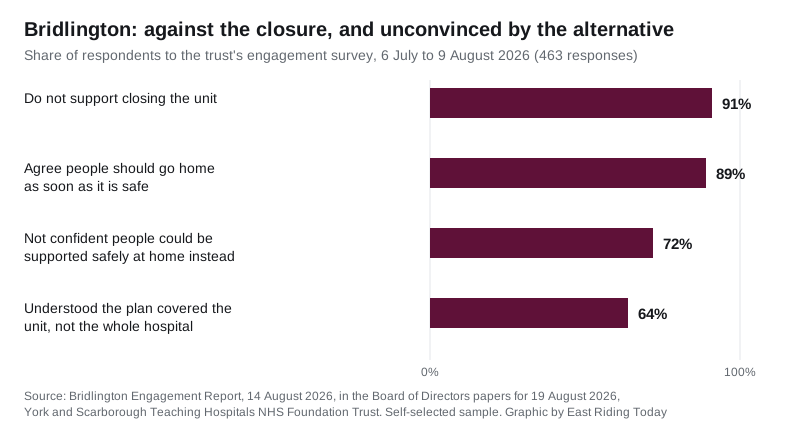
Those last two figures are the heart of it. Residents largely accept the principle of getting people home. They do not believe the services that would have to catch them are there.
Asked which services gave them the least confidence, respondents picked GP services (20% of choices) and social care (19%) ahead of everything else. Asked what would need to be in place before the unit could close, the top three answers were community services having enough staff, social care packages being arranged quickly, and people being able to get home safely.
Why the trust says it no longer needs the unit
Bridlington Care Unit opened in 2021 as a temporary Covid measure. Its job was to take patients who were medically fit to leave hospital but could not yet go home, mostly freeing beds at Scarborough Hospital. It was never a Bridlington-only service: the paper confirms the unit “takes admissions for any patient meeting the criteria”, so patients “are not exclusively from the Bridlington area”.
Two things then changed. The money that paid for it stopped at the end of March 2026. And the unit emptied out. The bed base was cut to a maximum of 15 in May 2026, and the paper records that actual use has run “significantly below this level”, at an average of about 10 patients a day since then.
The trust also checked whether shrinking the unit had backed up Scarborough Hospital. It reports that the number of patients waiting on discharge pathways 1, 2 and 3 did not rise beyond normal seasonal variation during the period of reduced capacity.
What replaces it
Patients who would have gone to the unit will instead be supported through community rehabilitation, community nursing, social care, frailty pathways and discharge-to-assess arrangements. The trust is explicit that it does not run those services itself.
In the East Riding they are delivered by:
- City Health Care Partnership, which provides district nursing and community therapies including physiotherapy and occupational therapy
- St Catherine’s Hospice, which supports community palliative care
- East Riding of Yorkshire Council adult social care, now part of a county-wide improvement programme begun after the 2025 Care Quality Commission inspection
- local care homes and other community facilities, which community services can use where a step-down bed is still needed
NHS Humber and North Yorkshire Integrated Care Board gave the board written assurance that these are being strengthened, through neighbourhood health teams, comprehensive geriatric assessment, frailty same-day emergency care and earlier discharge planning.
The opposition, and an apology
The campaign against closure was substantial and it is documented in the trust’s own papers.
- Bridlington and the Wolds MP Charlie Dewhirst presented a petition carrying 5,784 signatures, formally received by the board in May 2026.
- Three East Riding of Yorkshire councillors wrote to the trust raising concerns.
- Three MPs from outside the area wrote as part of what the trust describes as a coordinated campaign.
- Bridlington Health Forum wrote repeatedly, and met the trust’s executive team at the hospital.
- 250 people attended two drop-in events at Bridlington Spa on 27 and 28 July.
The engagement report, written by the trust’s director of communications Lucy Brown and dated 14 August, contains a notable admission about how the proposal was handled. “Despite best intentions of colleagues, the correct sequence of events for this engagement was not followed as colleagues were advised of the change before stakeholders had been briefed, resulting in them learning of the plans before being formally notified.”
Neither the trust nor the integrated care board classes the closure as a substantial variation in service, which is the test that would have triggered a formal public consultation rather than engagement.
Responding the day after the vote, Charlie Dewhirst said the decision was “deeply frustrating” and that “no detail was given yesterday about the nature or length of any transition arrangements”. He said it “should absolutely not have taken nearly 6,000 signatures on my petition to Parliament to make the NHS Trust bother with any public consultation whatsoever”.
The wider complaint: getting there
Transport was the most common theme across the whole engagement, not the unit itself. Residents described early appointments that no bus reaches, journeys to York, Scarborough, Malton, Hull or Selby involving several connections, and taxi fares they could not absorb. One example recorded in the report is a five-hour return journey for a ten-minute consultation.
Several people said they had been sent out of town for appointments that could have been done at Bridlington, and that a local slot only appeared once they challenged the booking. The report sums up the resulting mood in one phrase: a perception that Bridlington is a “forgotten hospital”.
Asked what they most wanted developed locally, respondents chose cancer and planned care, such as operations, diagnostics and outpatient appointments (33%), and acute illness assessment and treatment (29.9%), ahead of frailty and end of life care (18.6%).
What it means for you
If you or a relative are in hospital and expecting to come home with support, nothing changes today. The unit has not closed yet and no date has been announced. The trust says every patient still on the unit when closure begins will get an individual review before they move.
From that point, a Bridlington patient leaving Scarborough or York who would previously have gone to the care unit should be offered care at home instead, through community nursing, therapy, social care or a discharge-to-assess arrangement. If a bed is genuinely needed, the paper says community services can use local care homes.
Three practical points:
- The trust has committed to report back to the East Riding of Yorkshire health scrutiny committee on how implementation goes, so the monitoring is public.
- Charlie Dewhirst has asked residents to send him examples where the promised community or social care support does not materialise.
- The trust has separately said the future of the Bridlington Hospital site is a different question, still to be settled through its clinical strategy. Closing the unit is not a decision about the hospital.
As of today the trust’s website carries the board papers but no public statement on the outcome, and the integrated care board’s own briefing page on the unit has not been updated since April.
If travel to hospital appointments is your problem rather than the unit itself, our roadworks and travel page tracks the closures and disruption affecting journeys across the East Riding.
Sources: Extraordinary Board of Directors meeting papers, 19 August 2026 (York and Scarborough Teaching Hospitals NHS Foundation Trust), including the Bridlington Engagement Report of 14 August 2026; board of directors papers index; statement by Charlie Dewhirst MP, 20 August 2026.
Have your say